Valencia is preparing for its annual transformation. If you are planning to visit the city during Fallas 2026, you don’t need to belong to a private committee to enjoy the festival to the fullest. From the roar of gunpowder to the purification of fire, here is the definitive roadmap with the most spectacular events open to the public.
Introducing the Experiences Valencia guide to enjoying Fallas 2026
Table of Contents
- 1. La Crida: The Fallas Proclamation
- 2. Ninot Exhibition: The Popular Pardon
- 3. Ninot Parade: Satire in Motion
- 4. La Mascletà: The Gunpowder Concert
- 5. Street Lighting: The Festival of Light
- 6. La Plantà: The Birth of the Monuments
- 7. Special Section Fallas: The Cardboard Giants
- 8. The Offering: The Tapestry of La Geperudeta
- 9. Nit del Foc: The Night of Fire
- 10. La Cremà: The Sacrifice of Art
We begin with La Crida, the emotional ‘ground zero’ of the Fallas and a fundamental piece for understanding why this event marks the official permission for the festival to take to the streets.
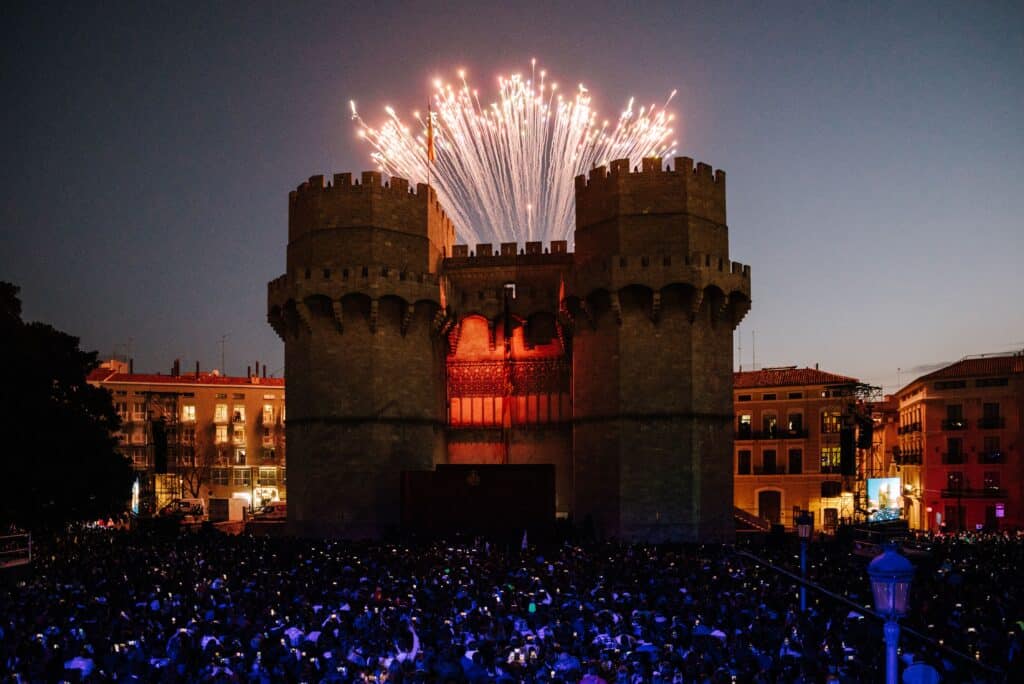
1. La Crida: The Fallas Proclamation
This is the official opening ceremony where the Fallera Mayor of Valencia makes a call (which is what Crida means in Valencian) to all citizens and visitors to join in the festivities. It is held at the foot of the imposing Serranos Towers, one of the ancient gates of the city’s medieval wall.
What does the event consist of?
It is not just a speech. It is a massive show that combines tradition and modernity:
- Audiovisual show: Projections on the stones of the Towers that tell the story of the festival.
- Protocol: The mayor hands over the keys to the city to the Fallera Mayor.
- Music and fireworks: The regional anthem is played (a spine-tingling moment) is performed, culminating in a fireworks display.
Location and logistics
- Location: Torres de Serranos (northern end of the old town, opposite the Turia riverbed).
- Date and time: 22 February at 7:30 p.m.
- Access: It is completely free and open to the public. However, the area around the towers is usually closed for safety reasons when maximum capacity is reached (around 40,000-50,000 people).
- Transport: The city centre is pedestrianised on this day. It is best to arrive by Metro (Pont de Fusta or Alameda stations) well in advance.
Expert tips for visitors
- The location dilemma: If you want to see the show up close, you should be there at least 2 or 3 hours early. If you prefer to avoid the oppressive crowds, you can stand on the parapet of the Turia riverbed (opposite the towers); you’ll have a panoramic view of the fireworks and the atmosphere without being ‘canned’.
- Clothing: At the end of February in Valencia, as soon as the sun goes down by the river, the humidity rises. Bring a jacket!
Cultural Curiosity
The most eagerly awaited phrase is: ‘Ja estem en Falles!’ (We’re in Fallas!). At that moment, the city officially ceases to be a normal city and becomes a giant museum and gunpowder workshop.
Let’s continue with the Ninot Exhibition: If you don’t have time to visit all 800 fallas that are set up around the city, the Ninot Exhibition is the perfect ‘trailer’ for the full film.
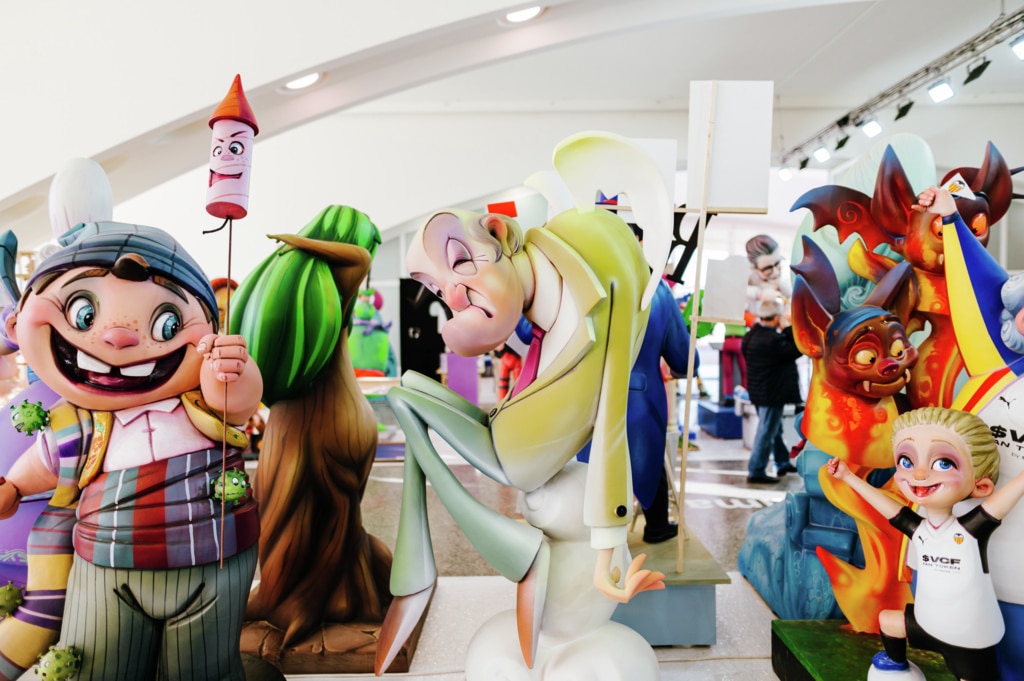
2. Ninot Exhibition: The Popular Pardon
This is a massive exhibition where each of the nearly 400 Fallas committees in Valencia presents their best piece (the ninot). The aim is to convince the public to vote for them and thus prevent their figure from being burned on the night of the Cremà.
What does the event consist of?
- You will walk among more than 750 figures divided into two sections: Children’s (sweet, fantastic and detailed) and Adults’ (satirical, political and, sometimes, spicy).
- The democracy of art: Upon entering, you will be given a ballot paper. When you leave, you cast your vote for the ninot you liked the most.
- The verdict: On 14 March (children’s) and 15 March (adults), the polls close. The one with the most votes becomes the Ninot Indultat and will live forever in the Fallas Museum, safe from the fire.
Location and logistics
- Location: Ground floor of the Príncipe Felipe Science Museum (in the City of Arts and Sciences).
It is a spectacular and modern setting that contrasts with the tradition of the figures.
Opening hours: From 7 February to 15 March, Monday to Thursday from 10:00 to 20:00, and Friday to Sunday from 10:00 to 21:00. - Admission: Ticket required. Reduced rates for children, seniors and groups. Tickets can be purchased on site or on the CAC’s official website to avoid queues.
Expert tips for visitors
- Pay attention to detail: Don’t just look at the figure’s face. Look at the textures, the paintwork (the sombrejat technique) and, above all, read the signs with verses (in Valencian or Spanish). That’s where you’ll find the social criticism and humour that defines the Fallas.
- The best time to visit: Go on a weekday morning. On weekends in March, the exhibition gets very crowded and it’s difficult to appreciate the details or take photos without people around.
Cultural curiosity
In the past, the exhibition was held in places such as La Lonja or the Central Market. The move to the Science Museum has given a ‘fine arts museum’ feel to a tradition that originated with 18th-century carpenters.
Next up is the most irreverent and entertaining event on the calendar. If the Ninot Exhibition we just saw is static and refined art, the Ninot Parade is that same spirit of satire but with dancing, music and a great desire to party.
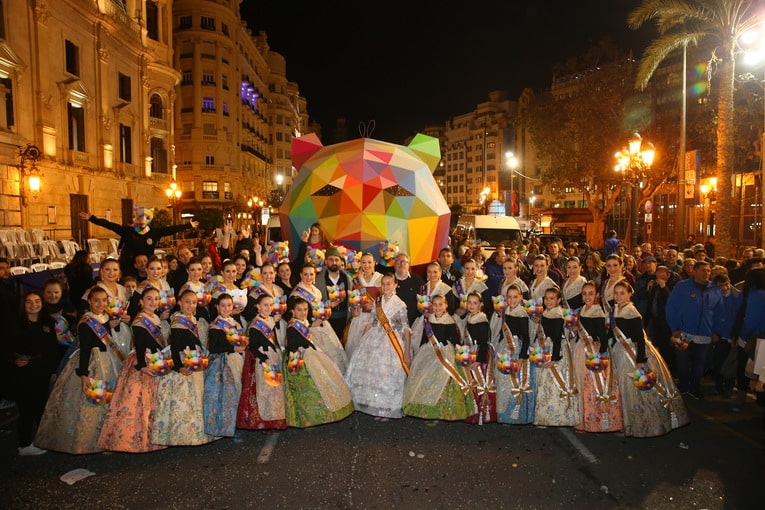
3. Cabalgata del Ninot: Satire in Motion
This is a parade where the Fallas committees dress up in costumes based on a critical or satirical theme. Don’t expect a parade of Disney floats; here, the focus is on irony, wit and, above all, social and political criticism of current events, all accompanied by marching bands and lots of energy.
What does the event consist of?
- Troupes and costumes: The fallas compete for the prize for the best troupe. The costumes are usually handmade with materials reminiscent of the falla itself (cardboard, cork, paint).
- Current affairs commentary: You’ll see parodies of politicians, social situations in Valencia during the year and international issues, always with a touch of Valencian humour.
- Floats: At the end of each section, there is usually a float carrying the Ninot that the falla has presented to the exhibition, symbolically taking it ‘for a walk’ before the big week begins.
- Royal Closing: The parade is closed by the Falleras Mayores of Valencia and their Courts of Honour, in a more solemn and formal tone.
Location and Logistics
- Route: Starting at the Glorieta in Alfons el Magnànim Square, La Pau Street, Sant Vicent, Ajuntament Square, Marqués de Sotelo and ending at Xàtiva Street. The parade will close with the entrance of the first pieces of the municipal falla ‘Hope’.
- Date and time: 28 February at 5.30 pm, but as there are many committees, it may go on well into the night.
- Access: It is completely free along the entire route.
Expert tips for visitors
- The best place: Calle de la Paz is beautiful for its architecture, but the Plaza del Ayuntamiento is where the comparsas usually perform their dances in front of the authorities’ tribune. That’s where the real action is!
- Patience and snacks: It’s a long event. If you’re going with children, find a place with a bench nearby or take something to eat (a good hot chocolate with buñuelos in the city centre is a must during Fallas).
- Keep an eye on the end: At the end of the parade (around 8 or 9 pm), there is sometimes a night-time Mascletà or fireworks display in the Town Hall Square to close the day. Don’t leave early!
Cultural curiosity
In the past, the Cabalgata del Ninot was used to transport the pieces of the falla from the artist’s workshop to the street where it was to be erected. Today, it is a massive costume and street theatre competition that shows that Valencians know how to laugh at everything, starting with themselves.
Next, we arrive at the beating heart of the Fallas! The Mascletà is not a conventional fireworks display; it’s not about watching, but about feeling. It’s a musical composition where the instruments are gunpowder and rhythm.
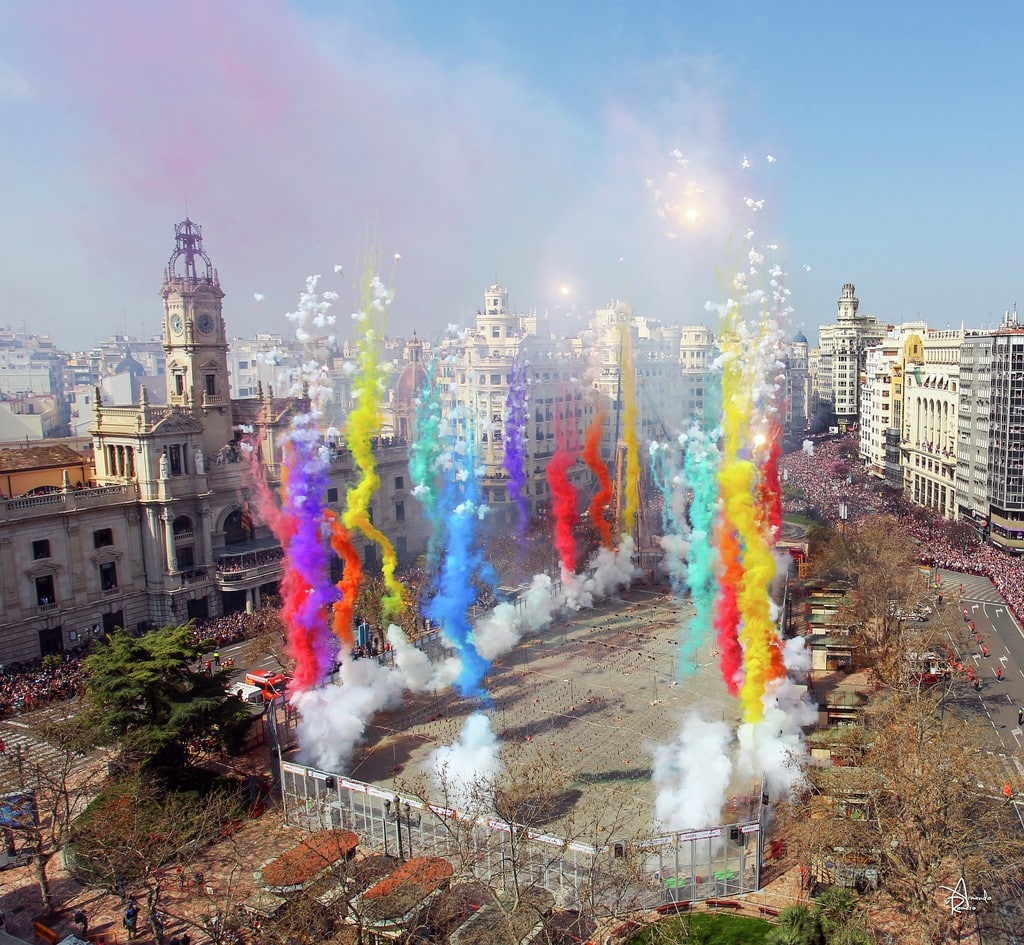
4. La Mascletà: The Gunpowder Concert
This is the most important daily event of the festival. For about 5 to 7 minutes, hundreds of kilos of gunpowder are fired progressively, increasing in intensity until the ‘final earthquake’, where the ground of Valencia literally vibrates under your feet.
What does the event consist of?
- The Ritual: It all starts at 2 pm sharp when the Fallera Mayor of Valencia, from the balcony of the Town Hall, utters the magic phrase: ‘Senyor pirotècnic, pot començar la mascletà’ (Master pyrotechnician, you may begin the mascletà).
- The Structure: It begins with aerial shots to attract attention, continues with a rhythm marked by terrestrial ‘thunderclaps’ and culminates in the final earthquake, a massive explosion of noise and smoke that makes you feel the sound in your chest.
- The Applause: When it’s over, people rush to the ‘cage’ (the fenced-off area) to cheer the pyrotechnician if the display has been good. It’s like the end of an opera.
Location and Logistics
- Location: Town Hall Square.
- Date and time: from 1 March to 19 March at 2 p.m.
- Transport: The centre is closed to traffic from approximately 11 a.m. Do not attempt to drive or take the bus nearby. The Metro (Xàtiva, Colón or Plaça d’Espanya stations) is the only option, but the stations become very crowded.
- Advance planning: If you want to be in the square, arrive at 12:30 p.m. or 1:00 p.m. By 1:30 p.m., it is almost impossible to enter.
Expert tips for visitors
- Keep your mouth slightly open: A health tip: when the noise becomes very intense at the end, keep your mouth slightly open. This helps to balance the pressure in your ears and prevents discomfort.
- Where to stand? If it’s your first time and you feel overwhelmed by the crowds, stay near the North Station or on Marqués de Sotelo Street. You’ll hear it just as loud, but you’ll have an easier escape route.
- The sun: The wait is long and under the March sun. Bring water, a hat and sunscreen. Standing in the sun for 90 minutes can be exhausting.
Cultural Curiosity
The Mascletà owes its name to the ‘masclet’, the type of firecracker used. For Valencians, a mascletà is not just noise; it is a rhythmic structure. If the rhythm is lost or the ending is not sharp and powerful, it is considered a ‘bad’ mascletà.
We continue with the Fallas lights. If the Mascletà is a spectacle for the ears, this is undoubtedly a spectacle for the eyes. When the sun goes down, some neighbourhoods in Valencia are transformed into veritable cathedrals of light. It is an event that turns a simple evening stroll into a magical experience.
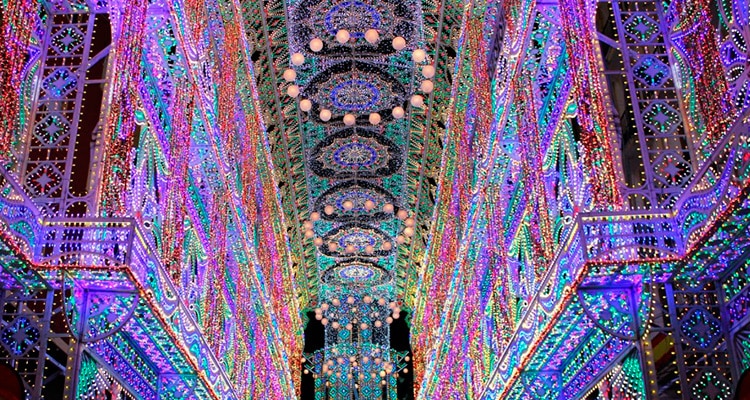
5. Street Lighting: The Festival of Light
Every year, several Fallas committees compete for the prize for best street lighting. It’s not just a matter of putting up light bulbs; these are massive architectural structures, porticos of light and avant-garde designs that cover entire streets.
What does the event consist of?
- The Ruzafa neighbourhood (Valencian ‘Soho’): This is the epicentre. This is where you’ll find the most famous fallas for their lights, such as Cuba-Puerto Rico, Sueca-Literato Azorín and Cuba-Literato Azorín. Historically, they used to put on light shows set to music, although now many opt for fixed installations with incredible artistic designs.
- Malvarrosa (Falla Av. Malvarrosa-Ponz-Cavite): A little further from the centre, next to the beach. It usually features a monumental structure, often a very long tunnel of light that is a unique visual spectacle.
- The Switch-On: The first day (7 March) is an event in itself. Thousands of people gather to see how, with a single switch, the lights come on.
Location and Logistics
- Ruzafa: This is a neighbourhood of narrow streets. The best way to get there is on foot from the Estación del Norte (about 10-15 minutes) or by Metro (Alacant or Bailén stations).
- Malvarrosa: You can get there by tram (lines 4 or 6) or by EMT buses going to the beach.
- Opening hours: Friday 6 March (around 8 pm) and they remain lit until well into the early hours of the morning during Fallas week.
Expert tips for visitors
- Ruzafa route: The best strategy is to go to Ruzafa around 9:00 or 10:00 p.m. on weekdays. On weekends, the neighbourhood becomes so crowded that it is almost impossible to walk.
- Fallera dinner: Take advantage of being in Ruzafa to have dinner at one of its many modern restaurants, but book weeks in advance. If you don’t have a reservation, look for a pumpkin fritter stand and eat it while strolling under the lights. It’s a 10/10 plan.
- Camera ready: This is the most ‘Instagrammable’ place in Valencia. If you want the perfect photo without people, you’ll have to go in the early hours of the morning (after 2 a.m.).
Cultural curiosity
This competition is so competitive that some committees invest tens of thousands of euros just to rent the lights. The companies that install them are usually among the best in the world (such as those that light up major events in Italy or the most famous Christmas celebrations).
We have reached the moment when the city undergoes a true transformation. Overnight, Valencia ceases to be a city of asphalt and becomes an open-air museum of ephemeral art with almost 800 monuments (both large and small) occupying every corner.
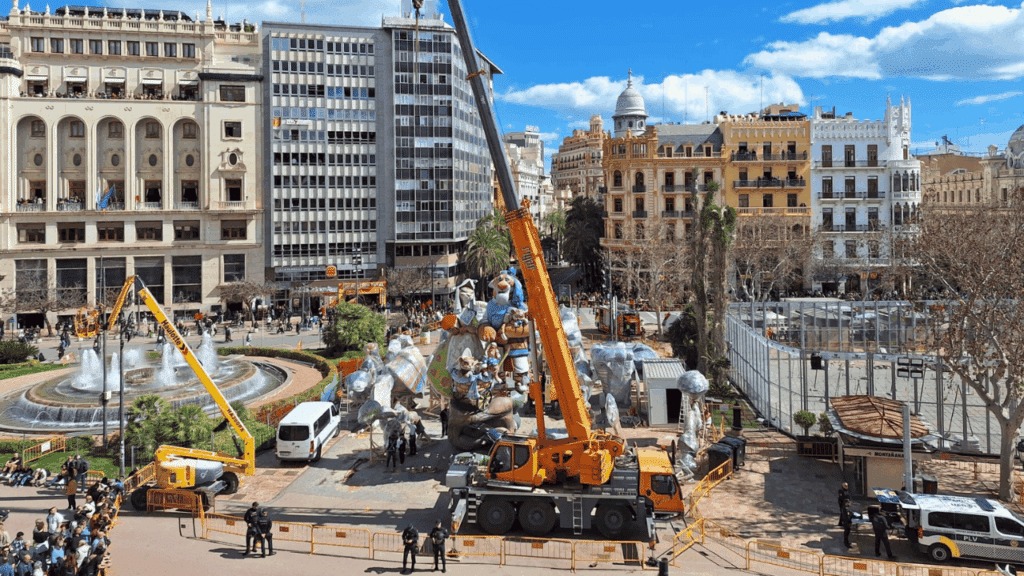
6. La Plantà: The Birth of the Monuments
This is the final assembly process for the fallas. Although the fallas artists have been working in the streets for days (or even weeks in the case of the largest fallas), La Plantà is the official deadline by which everything must be perfect for the jury to pass.
What does the event consist of?
- Plantà Infantil (15 March): In the morning, the youngest members of each committee help to assemble their falla. These are smaller-scale monuments, very detailed and with a sweeter or more fantastical visual language.
- Plantà de las Fallas Grandes (Night of 15 to 16): It is a night of frantic work. Giant cranes are used to fit the central pieces (called remates). The effort is maximum because early on the 16th, the jury will begin to tour the city to decide the prizes.
- The ‘Plantà al tombe’: There are still some fallas that are erected ‘the old-fashioned way’, i.e. without cranes, lifting the pieces using only the physical strength of the falleros with ropes and struts. It is an impressive community spectacle.
Location and Logistics
- Location: Throughout the city, from the centre to the outlying neighbourhoods.
- Date and time: 14th and 15th March, no fixed schedule.
- The centre of Valencia: Completely closed to traffic. Be prepared to walk a lot.
- Recommendation: Look for the fallas in the Special Section (such as Convento Jerusalén, Plaza del Pilar or Almirante Cadarso). They are the most spectacular and require the most powerful cranes.
Expert advice for visitors
- The night-time atmosphere: The night of the 15th is magical. Watching the artists touch up the paint with brushes, lay down artificial grass and place posters with social commentary under the spotlights is a unique experience. There are lots of people walking around and an atmosphere of constant anticipation.
- Watch out for the cranes: If you go to see the assembly, always respect the safety barriers. The artists work under a lot of pressure and with pieces that weigh tonnes.
- Take the opportunity to see the details: Once the plantà is finished, it is the best time to read the posters (la explicació) that accompany the falla, as they are still in perfect condition before the possible rain or wear and tear of the Fallas week.
Cultural Curiosity
In the past, the Plantà was the moment when neighbours took their old junk out onto the street to burn it. Today, the process is so complex that if a main piece breaks during assembly (known as ‘caure el remat’), it is a tragedy that mobilises the entire Fallas community to help.
If the Plantà is the birth, these days are the peak. The Fallas in the Special Section are the ‘Champions League’ of ephemeral art: monuments that can exceed 20 metres in height and budgets of hundreds of thousands of euros.
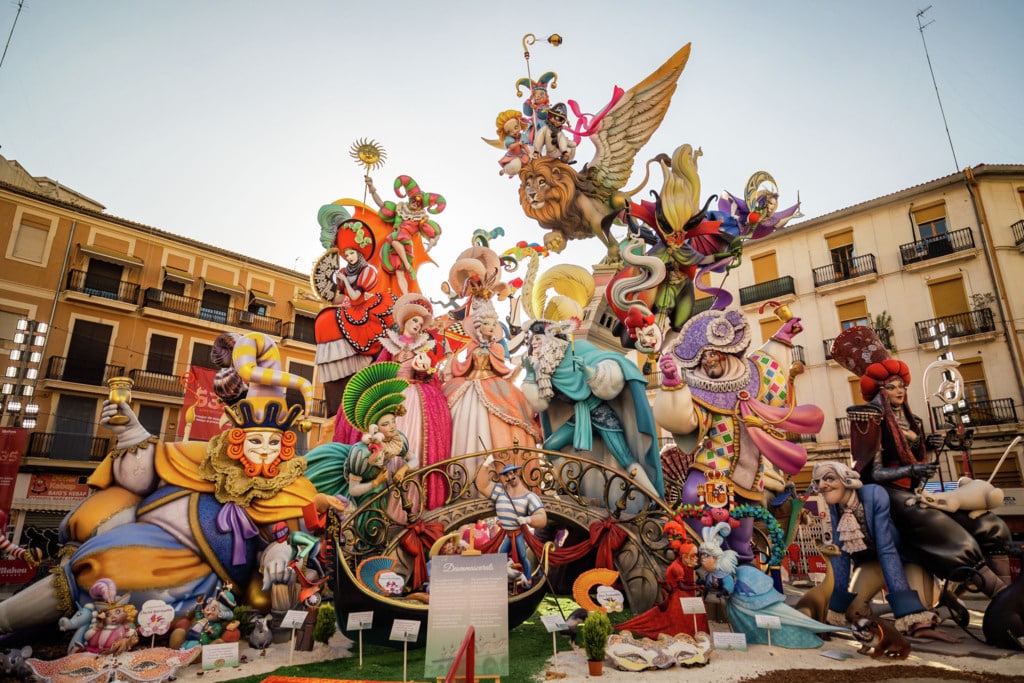
7. Fallas in the Special Section: The Cardboard Giants
These are the 9 or 10 fallas (the number varies slightly each year) that compete for the city’s top prize. They are veritable cathedrals of wood, cork and paint that defy gravity.
What does the visit consist of?
- Extreme detail: Unlike neighbourhood fallas, here each ninot is an individual work of art. The paintwork has perfect gradients and the scenes are full of biting social satire.
- The verdict (16 March): The prizes are announced in the afternoon. You’ll see the winning committees jumping and crying with joy next to their falla. It’s a moment of pure emotion.
- Free viewing: Although you can pay a small entrance fee to go inside the fenced area and see the details up close (highly recommended if you are an art fan), viewing them from the outside fence is completely free.
Location and Logistics (The ‘Essentials’)
They are scattered throughout the city, but are mainly grouped in three areas:
- Historic Centre: Convento Jerusalén – Matemático Marzal (near the Estación del Norte) and Plaza del Pilar (in a narrow square where the falla seems to touch the buildings).
- Ruzafa: Cuba-Literato Azorín and Sueca-Literato Azorín.
- Outside the city walls: Almirante Cadarso – Conde Altea (Cánovas area) and Exposición – Micer Mascó (near the Mestalla stadium).
Expert tips for visitors
- The Pilar Route: The Pilar Falla is famous for being so large that it barely fits in its square. Entering that square and looking up is an experience that makes you feel tiny.
- The ‘early morning’ moment: If you want to see them without 5,000 people around you, go between 7:00 and 9:00 in the morning. The dawn light is incredible for photos and you will have the monument almost to yourself.
- Footwear: You will walk an average of 15-20 km per day. Forget fashion and prioritise the most comfortable trainers you have.
Cultural curiosity
The Special Section was created in the 1940s to differentiate the fallas that were already beginning to stand out for their excessive size. Winning first prize in the Special Section is the greatest honour a fallero artist can receive; it is their direct entry into the history books of the festival.
Let’s move on to the next event, one of the most exciting of the Fallas. If the Mascletà is the noise and the Fallas in the Special Section are the art, the Offering is, without a doubt, the soul of the festival. It is the most eagerly awaited event for falleros and one of the most colourful and exciting parades to be seen anywhere in the world.
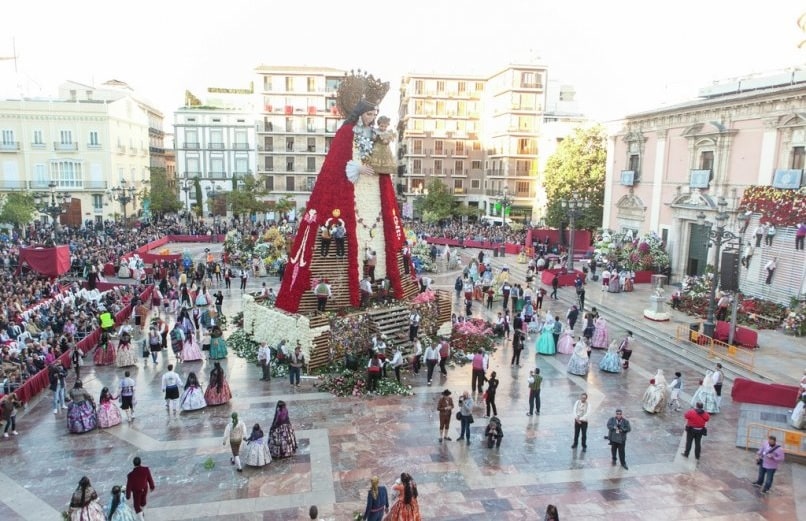
8. The Offering: The Tapestry of La Geperudeta
For two consecutive afternoons and evenings, thousands of falleros and falleras from all the committees in Valencia parade through the city centre to the Plaza de la Virgen to deliver bouquets of carnations to the city’s patron saint, the Virgin of the Forsaken (affectionately known as the ‘Geperudeta’).
What does the event consist of?
- The Mantle of Flowers: A giant wooden structure (about 15 metres high) with the bust of the Virgin is installed in the centre of the square. The ‘dressers’ (specialists who climb the structure) place the bouquets of the falleros to design a mantle of natural flowers with geometric patterns that change every year.
- The Parade: The falleros wear their finest traditional costumes. You will see thousands of silks, laces and gold and silverwork of incalculable value.
- The Emotion: For many falleros, arriving at the square and seeing the Virgin is the highlight of the year.
It is very common to see people crying with emotion as they hand over their bouquets.
Location and Logistics
- Route: The falleros arrive at the square via two main routes: Calle de la Paz and Calle San Vicente.
- Date and time: 17, 18 and 19 March from early evening until late at night.
- Final location: Plaza de la Virgen.
- Access: As a spectator, you can watch the parade from anywhere along the aforementioned streets. Please note! Plaza de la Virgen becomes practically inaccessible due to the large crowds and constant flow of falleros. It is best to watch the parade from the access streets.
Expert tips for visitors
- The scent of Valencia: If you want to enjoy the show with less stress, go to Plaza de la Virgen on the morning of the 19th. The Offering will already be over, the mantle will be complete, and the smell of thousands of fresh carnations flooding the square is something you will never forget.
- Crossing the street: During the Offering, crossing Paz or San Vicente streets is almost impossible. Look for the ‘pedestrian crossings’ set up by the police and be very patient; the parade does not stop.
- Listen to the music: Each falla is accompanied by its own band playing pasodobles.The soundscape is wonderful.
Cultural CuriosityThe colours of the carnations (white, red and pink) are not random. Each falla is assigned a specific colour so that the design of the mantle is perfect.
The dressers work blindly, following the instructions of a coordinator who knows exactly which colour goes in each hole in the wooden structure.
We continue our guide with the night of the fireworks. If the Fallas were an opera, the Nit del Foc would be the grand crescendo before the final act. It is the most important, longest and most expensive fireworks display of the entire festival. It is not just ‘a castle’, it is the night when Valencia literally has no sky due to the gunpowder.

9. Nit del Foc: The Night of Fire
This is the most iconic fireworks display, set off in the early hours of 18 to 19 March. For about 20 minutes, a master pyrotechnician uses thousands of kilos of gunpowder to create a choreography of lights, colours and sounds that can be seen from almost anywhere in the city.
What does the event consist of?
- Pure spectacle: Unlike the Mascletà (which is all about noise and rhythm), here the focus is on colour and height. You will see giant palm trees, ‘bombs’ with incredible effects and a spectacular finale that lights up Valencia as if it were daytime.
- Prestige: Setting off the Nit del Foc is the greatest honour for a pyrotechnician. They save their best tricks and most innovative effects for this night.
Location and Logistics
- Location: In the Turia riverbed, specifically in the area opposite the Palau de les Arts (City of Arts and Sciences).
- Time: 18 March at midnight, but bear in mind that this is the early hours of the morning between the 18th and 19th.
- Access: Free and open to the public. The bridges near the Palau de les Arts (such as Monteolivete and Las Flores) are the most popular viewing spots.
Expert tips for visitors
- The wind is key: Pay attention to where the wind is blowing. If the wind is blowing towards you, the smoke from the first shots will prevent you from seeing the rest of the castle. Always stand ‘windward’ (where the wind hits you in the face or from the side, never with your back to it if that means the smoke is coming towards you).
- Be extremely early: If you want to be in the front row on the river parapet, you have to go at least 2 hours early. Many people bring dinner and have a picnic there to save their spot.
- Leave calmly: When it’s over, thousands of people try to leave at once. Don’t rush and enjoy the atmosphere or walk a little towards the nearby neighbourhoods to avoid the human traffic jam.
Cultural Curiosity
It’s called ‘Nit del Foc’ (Night of Fire) because, in addition to the official castle, Valencia doesn’t sleep that night. The Fallas committees set off their own smaller castles in the streets, there are street parties on every corner, and the smell of gunpowder is so thick you can almost ‘chew’ it. It is the most intense night before everything burns.
We have reached the end of the road. La Cremà is the most paradoxical event of the Fallas: it is a mixture of sadness at the end of the festival and purification to start the cycle of the following year. It is the moment when art turns into fire and ashes.

10. La Cremà: The Sacrifice of Art
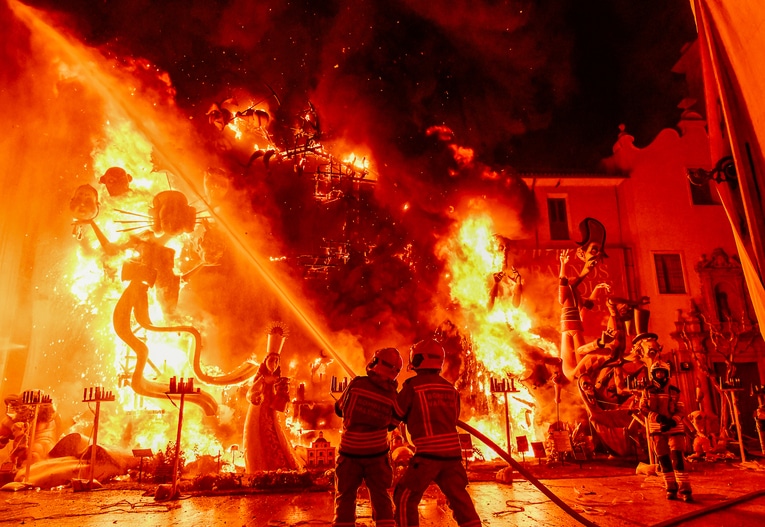
This is the final stage of the Fallas. All the monuments (almost 800) that we have seen being erected and awarded prizes in the previous days are consigned to the flames. In Valencia, for something new to be born, the old must burn.
What does the event consist of?
- The Fire Ritual: The ninots that the jury has decided to save from the fire are removed, holes are made in the base of the falla and it is filled with straw and petrol. After a small fireworks display, the fuse is lit.
- The Three Phases:
- 8:00 p.m. (Children’s): The small fallas burn first. This is the most emotional moment for the children of the commission.
- 10:00 p.m. (Large): The whole city is lit up in orange. The heat is so intense that it can be felt dozens of metres away.
- 00:00 (Municipal Fallas): This is the last to burn, in the Town Hall Square, marking the official end of the festivities.
- Accompaniment: While the falla burns, the commission’s band usually plays the anthem of Valencia, creating an atmosphere of respect and contained emotion.
Location and Logistics
- Location: At every street intersection where there is a falla. You don’t need to go anywhere specific; the whole city is ‘on fire’ in a controlled manner.
- Safety: You will see that the fire brigade is present at every major burning, cooling the facades of nearby buildings with water so that the heat does not break windows or damage homes.
Expert tips for visitors
- Choose your falla wisely: If you go to the Town Hall Square (the Municipal Square), there will be a lot of people and you will see the fire from a distance. If you want the real experience, look for a neighbourhood falla. You’ll be able to get closer (while respecting the safety cordon), feel the heat on your face and see the structure collapse.
- Wear comfortable clothes: Don’t wear new clothes tonight. Between the smoke, the ash that may fall from the sky and the smell of burning that will stick to you, it’s best to wear something old and comfortable.
- Take care of your eyes: If it’s windy, the embers (burning ash) can fly. If you wear contact lenses, it might be better to wear glasses that night.
Cultural CuriosityWhy are they burned? The origin comes from the ancient carpenters who, when spring arrived, cleaned their workshops and burned the old junk and wooden supports (parots) they used for lighting during the winter. It is a ritual of renewal.AND WITH THAT, THE ASHES ARE SWEPT AWAY AND VALENCIA BEGINS TO DREAM OF THE FALLAS OF 2027!
It has been a pleasure to take the readers and subscribers of Experiences Valencia through this guide to the events of the Fallas festival 2026.